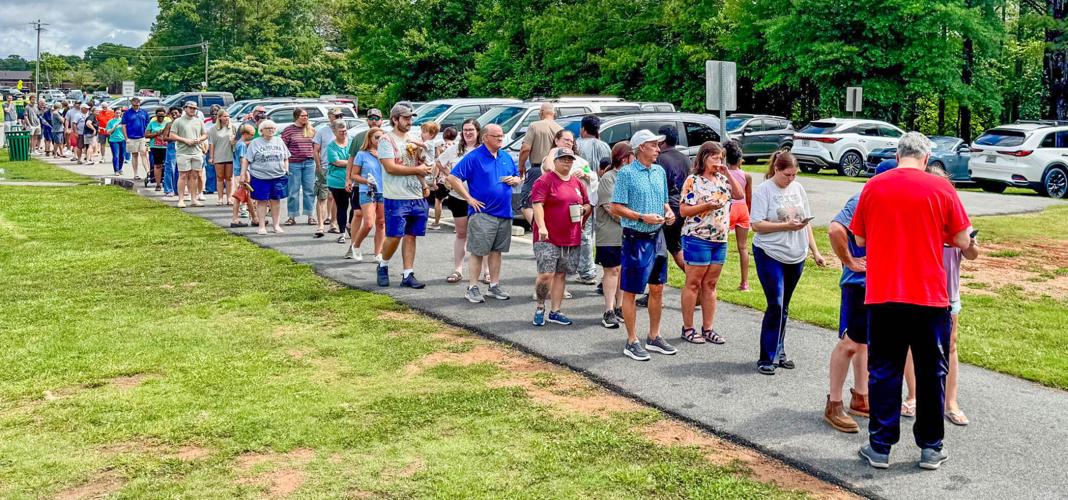
Large Crowds Turn Out to Fight Data Centers in Coweta County, Georgia
On a recent Saturday, residents of Coweta County, Georgia didn't stay home. They lined up.
At the Welcome Community Center and across multiple pop-up locations countywide, hundreds of Coweta residents gathered for events organized by Citizens for Rural Coweta, a grassroots group opposing the wave of data center developments proposed for their community. The crowds were large. The message was clear: not here.
The story, reported by The Newnan Times-Herald, captures what is becoming a familiar scene across rural America — communities mobilizing with urgency and organization against an industry that arrived faster than anyone had time to prepare for.
What Is Happening in Coweta County
Coweta County, located southwest of Atlanta, has found itself in the crosshairs of the data center industry's southward expansion. Tech companies have identified the region as a target for large-scale facilities — drawn by available land, relative proximity to Atlanta's fiber infrastructure, and a political environment that, until recently, offered few obstacles.
That calculus is changing. Citizens for Rural Coweta has been building momentum for weeks, and the weekend pop-up events were designed to do two things: collect petition signatures and give residents a place to show up and be counted. Both goals appear to have been met — and then some.
Residents waited in line to participate. That detail matters. These are not people who showed up because it was easy or convenient. They came because they are alarmed.
Why Coweta Residents Are Fighting Back
The concerns driving Coweta's resistance mirror those heard in communities from Michigan to North Carolina to Texas:
- Water: Data centers consume millions of gallons of water per day for cooling. In rural counties with limited water infrastructure, that demand competes directly with agricultural and residential needs.
- Land: Large-scale data center campuses consume hundreds of acres of land — often farmland and rural open space that communities have no interest in sacrificing.
- Noise: Industrial-grade cooling systems run 24 hours a day, generating constant low-frequency noise that degrades quality of life for nearby residents.
- Power grid strain: Data centers place enormous loads on local electrical grids, driving up costs for everyone else on the system.
- No community benefit: Despite industry promises of jobs and tax revenue, the actual employment footprint of modern automated data centers is minimal — often fewer than 50 permanent jobs per facility.
Georgia's Growing Resistance Movement
Coweta County is not alone. Georgia has seen a sharp uptick in community opposition to data center development in 2026. Camden County, on the state's coast, enacted a six-month moratorium on data centers in May 2026, becoming the first coastal Georgia community to do so — as reported by Stateline.
The pattern is consistent: communities that feel bypassed by the permitting process, given inadequate notice, or steamrolled by industry lobbyists are organizing and pushing back. And they are finding that when they show up — in numbers, with petitions, with legal arguments — they can slow or stop projects.
The National Context
This is happening against a backdrop of accelerating national resistance. A March 2026 Gallup poll found that 7 in 10 Americans would oppose a data center being built near them — a number that exceeds opposition to nuclear power plants. Dozens of cities and counties, from Denver to Bloomington to Huron County, Michigan, have enacted construction moratoriums in recent months.
The Lawrence Berkeley National Laboratory has projected that U.S. data centers will consume between 6.7% and 12% of all U.S. electricity by 2028 — up from 4.4% in 2023. Rural communities are being asked to absorb that burden without meaningful consent.
What Comes Next for Coweta
The petition signatures collected at Saturday's events will be presented to county commissioners. Citizens for Rural Coweta is calling for a moratorium on new data center approvals and a comprehensive impact study before any projects proceed.
The organizing is not over. It is just beginning.
What happened in Coweta County this weekend is what accountability looks like at the local level. Residents are not waiting for state or federal action. They are showing up, signing their names, and demanding that their community's future not be decided without them.
Sources and Citations
- The Newnan Times-Herald — Large crowds attend countywide anti-data center events
- Stateline — More cities are pressing pause on data centers as local backlash grows, May 28, 2026
- Gallup — Americans Oppose Data Centers in Their Area, March 2026
- Lawrence Berkeley National Laboratory — U.S. Data Center Energy Usage Report 2024
- The Current GA — Camden County Data Center Moratorium, May 2026
// DID THIS RESONATE?
CLICK TO SHOW YOUR SUPPORT
ORIGINAL SOURCE
The Newnan Times-Herald