As People Protest Data Centers Across the Heartland, Lawmakers Rush to Regulate Development
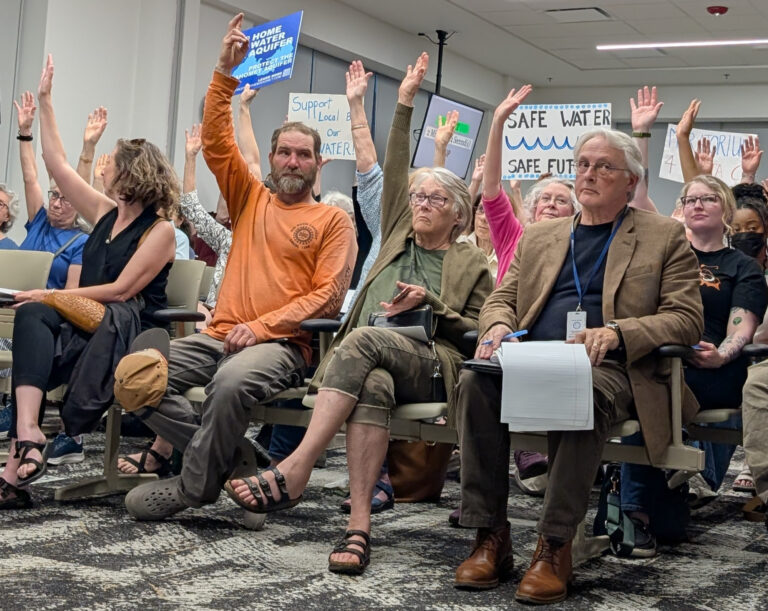
More than 100 people packed into tight county board chambers carrying signs reading "Protect Our Water" and "Approve the Moratorium."
They showed up at the Champaign County Board meeting in east central Illinois this spring to support pressing pause on development of large scale data centers — a move many communities have made in recent months in response to an influx of development proposals.
Dozens of people voiced concerns about the massive amounts of water and energy data centers use, including sixth grader Samuel Tomory, who's worried about the impact to Champaign County's water source, the Mahomet Aquifer.
"We need the water from our aquifer, but we do not need AI. We can just have the intelligence ourselves. We don't need the AI, as we need our water."
— Samuel Tomory, sixth grader, Champaign County, Illinois
The board unanimously passed the one-year moratorium in April, giving a new task force time to develop zoning standards for undeveloped land in the county.
A Spreading Movement
This pushback against data centers is becoming more common as development of large-scale facilities booms across the Midwest and South. More communities are fighting back — pointing to massive water and energy usage, and concerns about noise and landscape disruption.
Analysis from Pew Research Center finds the Midwest alone is set to see a 64% increase in data center development — and overwhelmingly, the development is planned for rural areas. About two-thirds of planned data centers in the U.S. are located in rural communities.
- Hill County, Texas: What some are calling the first data center moratorium in Texas passed in May — about an hour south of Fort Worth.
- Manitowoc County, Wisconsin: An 18-month moratorium passed in April.
- Huron County, Michigan: A three-year moratorium passed in May.
- Champaign County, Illinois: A one-year moratorium passed unanimously in April.
Debates Get Divisive
The effort worked in Champaign County — at least for now. But an hour away in Springfield, the data center debate went a different way. In April, the Sangamon County Board approved a controversial $500 million data center after several contentious public meetings.
"The developers are taking advantage of that," said Lori McKiernan of the nonprofit Sustainable Springfield. "They're going to these communities that don't have strong zoning."
Petitioners in the Springfield area are currently gathering signatures to remove the county's board chair and Democratic caucus leader from their leadership positions.
In Festus, Missouri, a suburb of St. Louis, the community voted out half of its city council after it approved a $6 billion data center deal. Newly-elected council member Rick Belleville ran specifically to bring transparency to the project.
"When somebody comes to town and says, 'Hey. We're gonna give you millions of dollars, and we're gonna build a data center,' you need to slow down and get a full understanding of how the full thing's gonna affect their community."
— Rick Belleville, newly-elected council member, Festus, Missouri
Changing Tides: State Legislatures Act
State lawmakers are also moving. Missouri passed a law raising rates for customers using large amounts of energy. Petitioners in Ohio are collecting signatures for a proposed constitutional amendment banning new large-scale data centers. Legislation was introduced in Illinois, Iowa, Minnesota, Oklahoma, and Wisconsin this year to tighten regulations.
"I think people are trying to catch up," said Dave Owen, a law professor at UC San Francisco who studies the energy impacts of data centers.
"I don't think really anybody foresaw how much of a popular backlash there would be against data centers. Even a year and a half ago, a lot of state and local governments were very eagerly trying to court data centers."
— Dave Owen, UC San Francisco law professor
Kate Stoll with the American Association for the Advancement of Science noted the trend: "We're also seeing some trends of cities and counties setting pauses or moratoria on data centers while they kind of shore up their data center specific policies in this time of rapid growth."
Originally reported by Abigail Bottar for IPM Newsroom, June 8, 2026.
// DID THIS RESONATE?
CLICK TO SHOW YOUR SUPPORT
ORIGINAL SOURCE
IPM Newsroom