Stop Steel-ing: The NDAs Hiding What Data Centers Are Doing to Our Communities
A protest graphic circulating across social media captures the growing fury of communities shut out of decisions about the industrial facilities being built in their backyards.
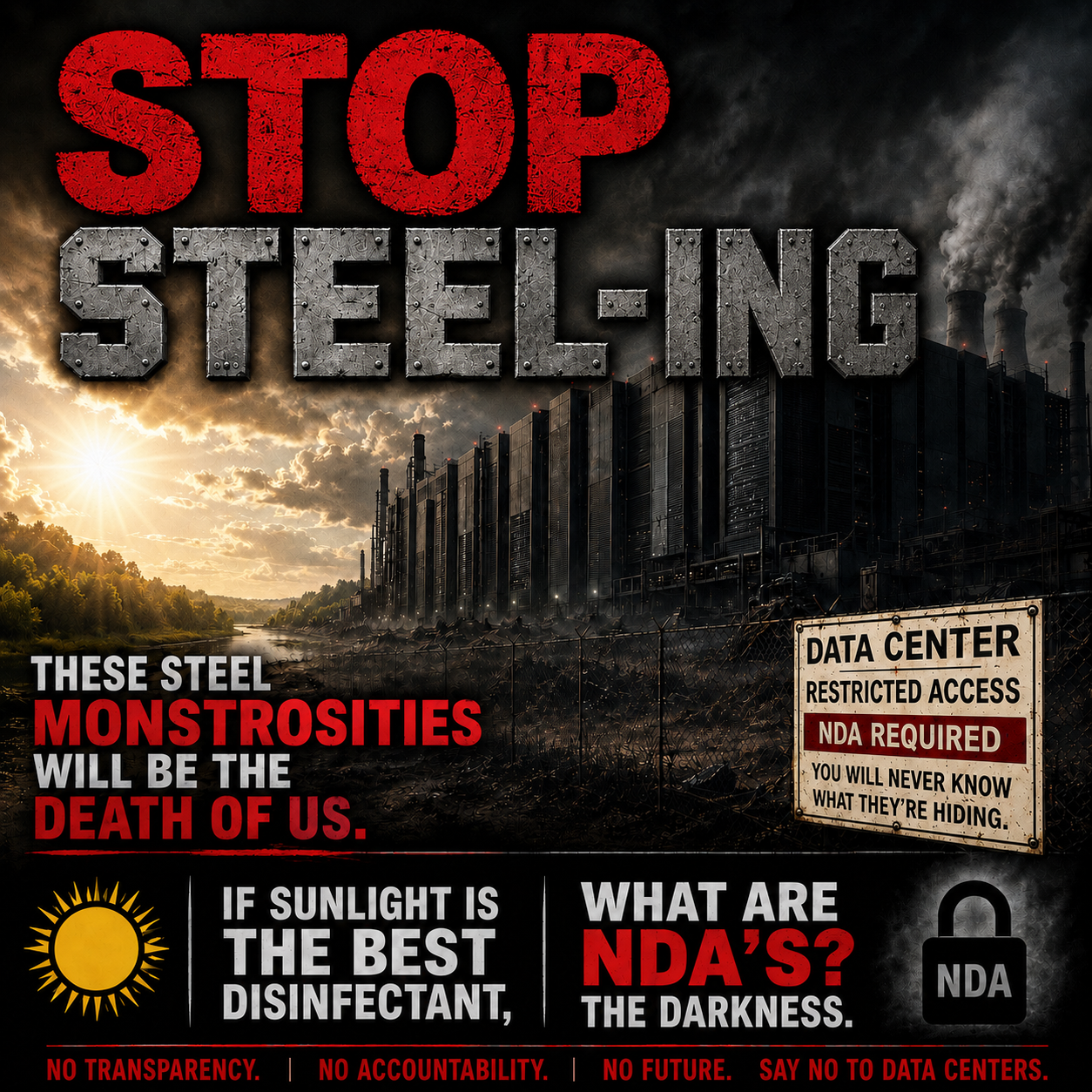
"These Steel Monstrosities Will Be the Death of Us"
The image is stark: an enormous, fortress-like industrial building silhouetted against a dying sun, thick smoke pouring from cooling towers, a desolate fenced-off foreground. The message is blunter still.
"STOP STEEL-ING."
It's a pun that cuts deep. Data centers — the hulking steel boxes powering the AI boom — are being erected across America at breakneck speed, and the communities forced to live beside them are increasingly being told to look the other way. Literally. Behind chain-link fences. Behind "Restricted Access" signs. Behind non-disclosure agreements.
If Sunlight Is the Best Disinfectant, What Are NDAs?
The graphic's central question lands like a hammer. The phrase "sunlight is the best disinfectant" — long a touchstone of open-government advocates — is turned against the data center industry with surgical precision.
If transparency is how we expose rot, then non-disclosure agreements are how we hide it. And the data center industry is wrapped in them.
Residents near proposed sites report being asked to sign NDAs just to attend informational meetings. Local officials sign agreements that gag them from discussing the projects they're voting on. Workers who build and maintain the facilities are bound by confidentiality clauses that prevent them from ever describing what happens inside.
The sign in the graphic says it plainly:
DATA CENTER
RESTRICTED ACCESS
NDA REQUIRED
"You will never know what they're hiding."
No Transparency. No Accountability. No Future.
The bottom banner of the graphic reads like an indictment — and it is one. The three-part refrain distills the core grievance of the anti-data-center movement into nine words:
No transparency. Communities aren't told what's being built, how much water it will draw, how much power it will consume, or what chemicals it will release. Environmental impact statements are often redacted, delayed, or buried.
No accountability. When things go wrong — a water aquifer runs dry, a transformer blows, a community's power bills spike — there is rarely a clear culprit. The corporate structures are labyrinthine. The subsidiaries are shell companies. The blame is diffused across a supply chain that spans continents.
No future. The graphic's final warning. If we allow these facilities to multiply unchecked, shielded by secrecy and shielded by steel, we are mortgaging the livability of our communities for a technology whose benefits remain largely theoretical for the people who bear its costs.
The Steel Is Real. The Secrecy Is Real. The Resistance Is Growing.
The "steel" in "Stop Steel-ing" is not metaphor. These facilities are built from thousands of tons of structural steel, their server racks are steel, their cooling systems are steel, their fencing is steel. They are monuments to a particular kind of industrial ambition — the kind that treats the surrounding community as an externality.
But the resistance is no longer confined to a single town or a single state. From Wasilla, Alaska to Naples, Florida, from the small borough of Kenilworth, New Jersey to the sprawling plains of Texas, Americans are organizing, petitioning, litigating, and — as this graphic attests — creating the visual language of a movement.
The question the graphic poses is not really about sunlight or darkness. It's about power. Who has it. Who's hiding behind it. And who's finally pushing back.
Say no to data centers.
// DID THIS RESONATE?
CLICK TO SHOW YOUR SUPPORT
ORIGINAL SOURCE
Community Submission