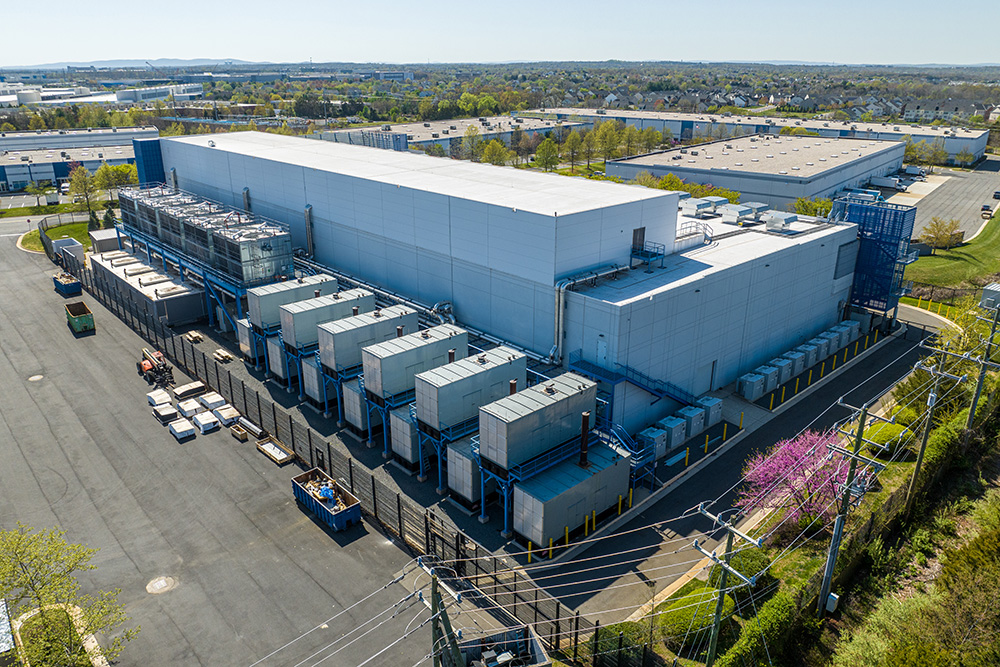
The Secret Coal Plant in the DC Suburbs: How Data Centers Are Quietly Poisoning Our Air, Water, and Climate
The Rapid Growth No One Voted For
The rapid growth of data centers is quickly overwhelming utilities, undermining environmental goals, increasing public health impacts, and putting ratepayers at risk of dramatically increased costs for the infrastructure and extraordinary power demands of these facilities. [1]
Data centers are massive facilities that power cloud computing and our digital infrastructure, and they are rapidly expanding across the United States. Once concentrated in a few regions, data center development has surged nationwide in recent years. The increasing demand for computing power — fueled by artificial intelligence and cryptocurrency — is placing unprecedented strain on the energy grid, land, water resources, and the health of local communities. [1]
Utilities are being pushed to build new power plants, often fueled by fossil fuels, to serve these facilities' around-the-clock electricity needs. Without strong safeguards, households and small businesses could be left paying for costly infrastructure while communities face worsening air pollution, water stress, and land-use conflicts. [1]
The Fossil Fuel Reality Behind the Cloud
Despite the industry's clean-energy rhetoric, the numbers tell a different story. About 56% of the electricity used to power data centers nationwide comes from fossil fuels, according to a peer-reviewed study published in Environmental Burden of United States Data Centers in the Artificial Intelligence Era. [2] Data centers' projected electricity demand in 2030 is set to increase to up to 130 GW (or 1,050 TWh), which would represent close to 12% of total U.S. annual demand. [3]
The International Energy Agency confirms that between 2024 and 2030, nearly 50% of the additional electricity generated for data centers is projected to come from fossil fuels. [4] Goldman Sachs estimates that future demand for electricity from data centers to 2030 will be met 60% by gas and 40% by renewable sources. [5]
Utilities are rushing to build gas plants, and the administration has promised to bring zombie coal plants back online — all to meet the needs of data centers, putting critical climate progress at risk. [1]
A Secret Coal Plant in the DC Suburbs
Sierra Club's new survey of air permits in Virginia reveals a staggering truth hiding in plain sight: diesel generators at data centers in Virginia have been permitted to emit nearly 13,000 tons of toxic oxides of nitrogen (NOx) and over 650 tons of particulates (PM) — comparable to the largest coal plants in the country. [1]
If these data centers hit their permitted limits, Sierra Club estimates as many as 177 additional premature mortalities from new air pollution every year, concentrated in Northern Virginia and Maryland. [1]
The Washington Post's own analysis found that pollution from generators at data centers could cause respiratory symptoms and deaths across the region. [6] Diesel exhaust releases fine particulate matter (PM2.5), nitrogen oxides (NOx), and other toxic pollutants that penetrate deep into the lungs. [7]
In Mississippi, an xAI facility's 27 natural gas-powered turbines were found to emit a "staggering amount of toxic air pollution each year" — including 2,507 tons of smog-forming nitrogen oxides, 236 tons of fine particulates, 837 tons of carbon monoxide, and 25 tons of formaldehyde. [8]
The Carbon Cost of AI
The environmental toll begins even before a data center is built. Researchers at the University of Massachusetts, Amherst found that training a single AI model can emit as much carbon as five cars over their entire lifetimes — more than 626,000 pounds of carbon dioxide equivalent. [9] That figure includes not just the final training run, but the thousands of trial runs that went into producing the finished model.
Water, Land, and the Cost Shifted to You
These facilities consume as much energy as a mid-sized city, like Orlando. They use an enormous amount of water — Loudoun County's data centers alone used over 1 billion gallons of water in 2023 — and occupy hundreds or even thousands of acres. [1]
The cost implications are dire for everyday Americans. Big data centers need a lot of generation and transmission infrastructure, and for many utilities those costs are shared by all customers — including everyday household ratepayers. Energy cost increases of up to 267% have been documented near data center developments. [1] And if the AI boom shrinks, utilities and their customers could be left holding the bag for all of those costs. [1]
Four Guardrails Sierra Club Is Fighting For
Sierra Club has released its 2026 Data Center Policy Guidance for local lawmakers, regulators, and advocates, built on four key guardrails: [1]
- Protecting customers from higher bills: Data centers, not individual ratepayers, should pay for all of their electricity needs. This includes binding "large load tariffs" that lock data centers into paying a set monthly bill. [1]
- Transparency in environmental impact: Tech companies often hide the true resource costs of new development through nondisclosure agreements with local officials. We need transparency on power, water, noise, and backup generation plans. [1]
- Improving the grid with clean energy: Data center developers must buy the vast majority of their power from renewable energy, not trigger new gas plants or delay retiring coal plants. [1]
- Community pushback for bad projects: When projects increase customer costs, put diesel generators in environmental justice communities, or use water irresponsibly, they must be stopped. [1]
Victories Are Happening
Across the country, Sierra Club and partners have helped win new state and utility policies that protect customers and communities — including rates that make sure data centers pay their own way, transparency requirements, and new ways for technology companies to invest in clean energy in states like Oregon, Missouri, Michigan, Nevada, and Virginia. [1]
Sierra Club Michigan helped lead a rapid, statewide campaign to confront the sudden surge of hyperscale AI data center proposals and the converging forces behind them. [1]
What You Can Do
If you want to stay informed about what's happening in your community or help ensure strong safeguards are in place as data centers move in, get engaged early and follow the permitting process. Data centers move through several levels of approval — local permits, air permits, and Public Service Commission proceedings. At each step, you have opportunities to take action:
- Submit a public comment or testify at a hearing
- Organize your community
- Share information so others understand the stakes
- Support organizations like Sierra Club that are fighting for guardrails [1]
The cloud is not clean. The cloud is not free. And unless we fight for it, the cloud will be built on our lungs, our water, and our electric bills.
Sources & Citations
- Sierra Club. "Data Centers." Sierra Club Climate Issue Page, 2026. (Includes 2026 Data Center Policy Guidance and Virginia air permit survey.)
- "Environmental Burden of United States Data Centers in the Artificial Intelligence Era." arXiv, 2024. (Fossil fuels produced more than 56% of electricity consumed by data centers.)
- Lawrence Berkeley National Laboratory. "2024 United States Data Center Energy Usage Report." (Data centers could represent up to 12% of total U.S. electricity demand.)
- International Energy Agency. "Energy and AI: Energy Supply for AI." (Nearly 50% of additional data center electricity from fossil fuels by 2030.)
- Opportunity Green. "Data Centres." (Goldman Sachs estimate: 60% gas, 40% renewables by 2030.)
- The Washington Post. "Data Centers Boom, Virginians Breathe Exhaust From 10,000 Diesel Generators," May 2026.
- Sierra Club Virginia. "Looser Rules, Dirtier Air: Data Centers and Diesel Pollution in Virginia," January 2026.
- Southern Environmental Law Center / NAACP. "Court Action to Stop Illegal Air Pollution from xAI's Data Center Power Plant."
- Strubell, E., Ganapathi, R., & McCallum, A. "Energy and Policy Considerations for Deep Learning in NLP." University of Massachusetts, Amherst, 2019. (Training a single AI model can emit 626,000 lbs CO2 — five cars' lifetime emissions.)
// DID THIS RESONATE?
CLICK TO SHOW YOUR SUPPORT
ORIGINAL SOURCE
Sierra Club