Our Community Is Not Your Data Mine: The Two-Headed Threat of Hyperscale Data Centers and Flock Surveillance Cameras
Two Arms of the Same Machine
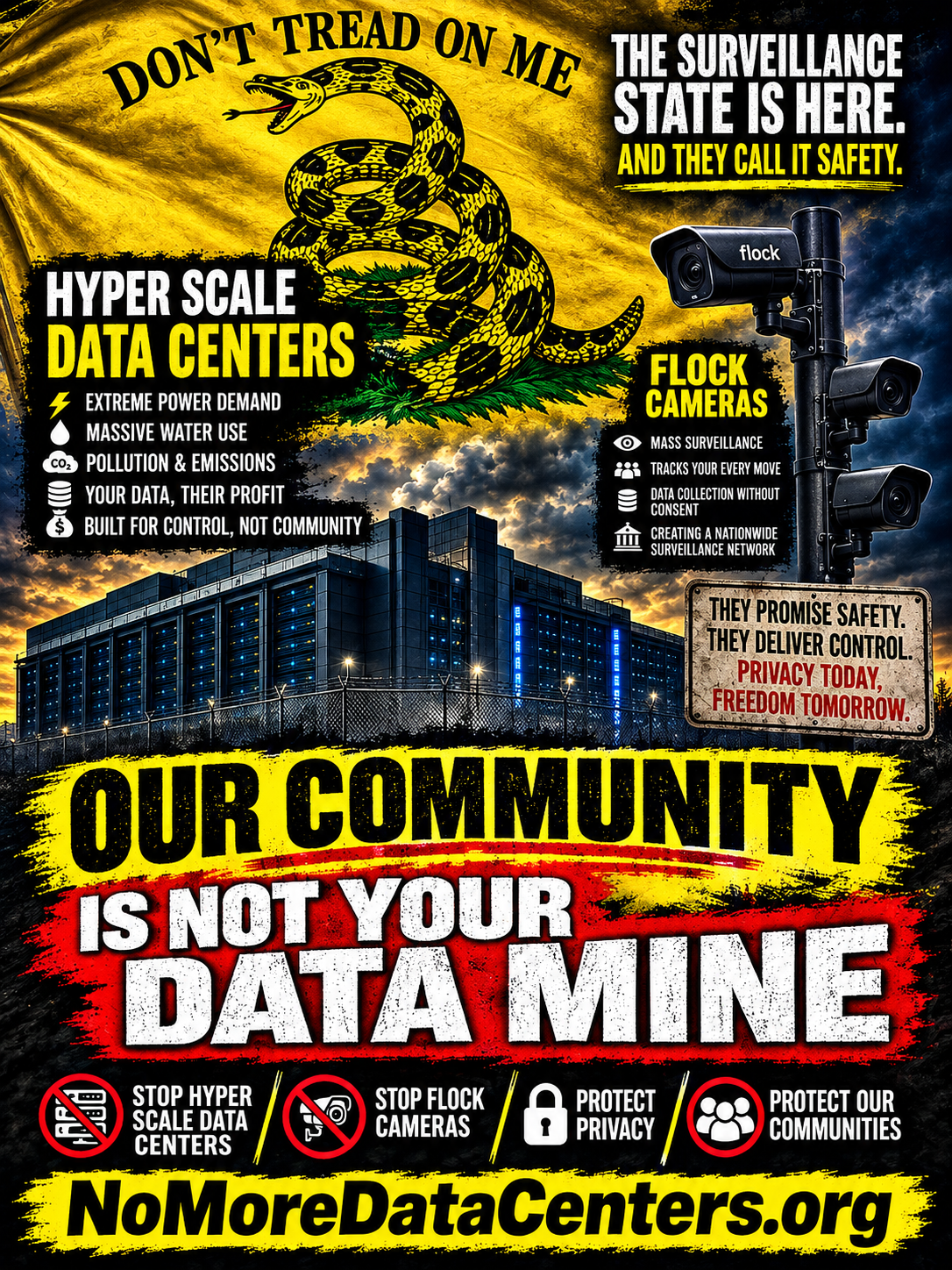
Look closely at the graphic above. On the left: hyperscale data centers — windowless fortresses that devour electricity and water, pumping out pollution while harvesting your data for profit. On the right: Flock surveillance cameras — mounted on poles in your neighborhoods, silently logging every license plate that passes, building a nationwide lattice of recorded movement.
These are not separate issues. They are two arms of the same machine. One mines your data. The other tracks your body. Both are sold to us under the same promise — safety — and both deliver the same thing: control.
Hyperscale Data Centers: Extreme Power, Massive Water, Your Loss
A conventional data center draws as much electricity as 10,000 to 25,000 households, according to the International Energy Agency. But a newer, AI-focused "hyperscale" data center can use as much power as 100,000 homes or more. [1] Meta's Hyperion data center in Louisiana is expected to draw more than twice the power of the entire city of New Orleans once completed. Another Meta data center planned in Wyoming will use more electricity than every home in the state combined. [1]
The water toll is equally staggering. Larger data centers require up to 5 million gallons of water every day — as much as a city of 50,000 people. [1] A study by the Houston Advanced Research Center and University of Houston found that data centers in Texas alone will use 49 billion gallons of water in 2025, and as much as 399 billion gallons in 2030 — equivalent to drawing down Lake Mead by more than 16 feet in a single year. [1]
In Newton County, Georgia, a single Meta data center uses 500,000 gallons of water per day — 10 percent of the entire county's water consumption. [1] Roughly two-thirds of data centers built since 2022 have been located in water-stressed regions, including hot, dry climates like Arizona. [1]
And the pollution? About 56% of the electricity used by U.S. data centers comes from fossil fuels, according to a peer-reviewed study published in Environmental Burden of United States Data Centers in the Artificial Intelligence Era. [2] Sierra Club's survey of Virginia air permits revealed that diesel generators at data centers are permitted to emit nearly 13,000 tons of toxic NOx and over 650 tons of particulates — comparable to the largest coal plants in the country — with an estimated 177 additional premature mortalities every year. [3]
Flock Cameras: A Nationwide Surveillance Lattice
Flock Safety has 120,000 automated license plate reader (ALPR) and pan-tilt-zoom cameras deployed throughout the United States, capturing tens of billions of data points a month. [4] Because every Flock camera is connected to the same network, the result is a nationwide lattice of recorded activity — a police officer in one state can be alerted if a car they're looking for pops up in another. [4]
Flock's default setting retains data for 30 days, but local departments can extend that. And despite the company's claims that it only logs vehicles, 404 Media reported that a Flock capability called "FreeForm" allows users to search camera records based on what someone was wearing, their tattoos, or even their race. [4] Police have also been caught using the system to stalk ex-partners and colleagues — more than a dozen documented cases of officers accused of or arrested for using Flock to harass and track people. [4]
"There's the idea of the open road, the freedom to drive," said Dave Maass, director of investigations at the Electronic Frontier Foundation. "A lot of people treat their cars like an extension of their homes." The idea that a company constantly tracks what a car does — whether it was involved in a crime or not — violates people's expectations of privacy in their personal space and of freedom of movement simultaneously. [4]
The Backlash Uniting Left and Right
Here is what the surveillance state did not see coming: opposition to both data centers and Flock cameras is one of the rare issues binding Americans across the ideological spectrum. [4]
"Rational people know it comes down to violating personal liberties," said Adrien Kaiser, a self-described constitutional conservative from Texas.
"A surveillance state is the first step towards a police state," said Jon Dendy, a progressive in Massachusetts.
"Conservatives are concerned with big government. And for progressives it's the idea of abuse by the government. We see the same problem from two different angles." [4]
City governments have joined citizens in pushing back — deactivating cameras or canceling Flock contracts in Fort Collins, Colorado; Eugene, Oregon; Madison, Wisconsin; Knoxville, Tennessee; Syracuse, New York; and Walla Walla, Washington. [4] Meanwhile, communities from Virginia to Georgia to Arizona are fighting hyperscale data center proposals that would drain their water, pollute their air, and jack up their electric bills. [1]
They Promise Safety. They Deliver Control.
The data center and the surveillance camera are sold to us with the same word: safety. Safety from crime. Safety from outages. Safety from the unknown. But as Tucker Carlson — no one's idea of a leftist — put it: "If you were to give up all privacy, you would in exchange get what? Safety. Of course. And that's the trade always. The problem is it hasn't worked that way because safety has never been a priority of this ruling class." [4]
The data centers are not built for your community. They are built for control — of compute, of resources, of the future. The cameras are not installed for your safety. They are installed for control — of movement, of dissent, of you.
Our community is not your data mine. Our roads are not your evidence file. Privacy today, freedom tomorrow.
What You Can Do
- Show up to permit hearings — data centers and camera deployments both move through local approval processes. Your voice matters at each step.
- Demand transparency — how much power, how much water, how many cameras, how long is data retained? If they won't tell you, that's the answer.
- Support the organizations fighting back — Sierra Club, Electronic Frontier Foundation, Southern Environmental Law Center, and the local coalitions springing up in your state. [1][3][4]
- Share this message — the surveillance state depends on silence. The resistance depends on noise.
Sources & Citations
- Lincoln Institute of Land Policy. "Data Drain: The Land and Water Impacts of the AI Boom." (Hyperscale data centers use power equivalent to 100,000+ homes; up to 5 million gallons of water per day; Texas projected at 399 billion gallons by 2030; Newton County Meta at 500,000 gallons/day.)
- "Environmental Burden of United States Data Centers in the Artificial Intelligence Era." arXiv, 2024. (56% of data center electricity from fossil fuels.)
- Sierra Club. "Data Centers." (Virginia diesel generators permitted for 13,000 tons NOx and 650 tons PM; 177 estimated premature mortalities per year.)
- ABC7NY / CNN Wire. "Flock cameras are getting mobbed nationwide," July 2026. (120,000 Flock cameras deployed; FreeForm race/clothing searches; police stalking cases; bipartisan opposition; cities canceling contracts.)
// DID THIS RESONATE?
CLICK TO SHOW YOUR SUPPORT
ORIGINAL SOURCE
No More Data Centers