USA TODAY to America: It's Time to Start Caring About Data Centers
On September 3, 2026, USA TODAY published a piece that reads like a manifesto for a movement that has been building in farm towns, suburban cul-de-sacs, and county boardrooms for years. Headlined "It's time for you to start caring about data centers. Here's why," the article by Greta Reich does something the mainstream press has been slow to do: it states plainly that the buildings powering the AI boom are not benign, and that the people living next to them have reason to fight.
The Buildings Are Not the Same
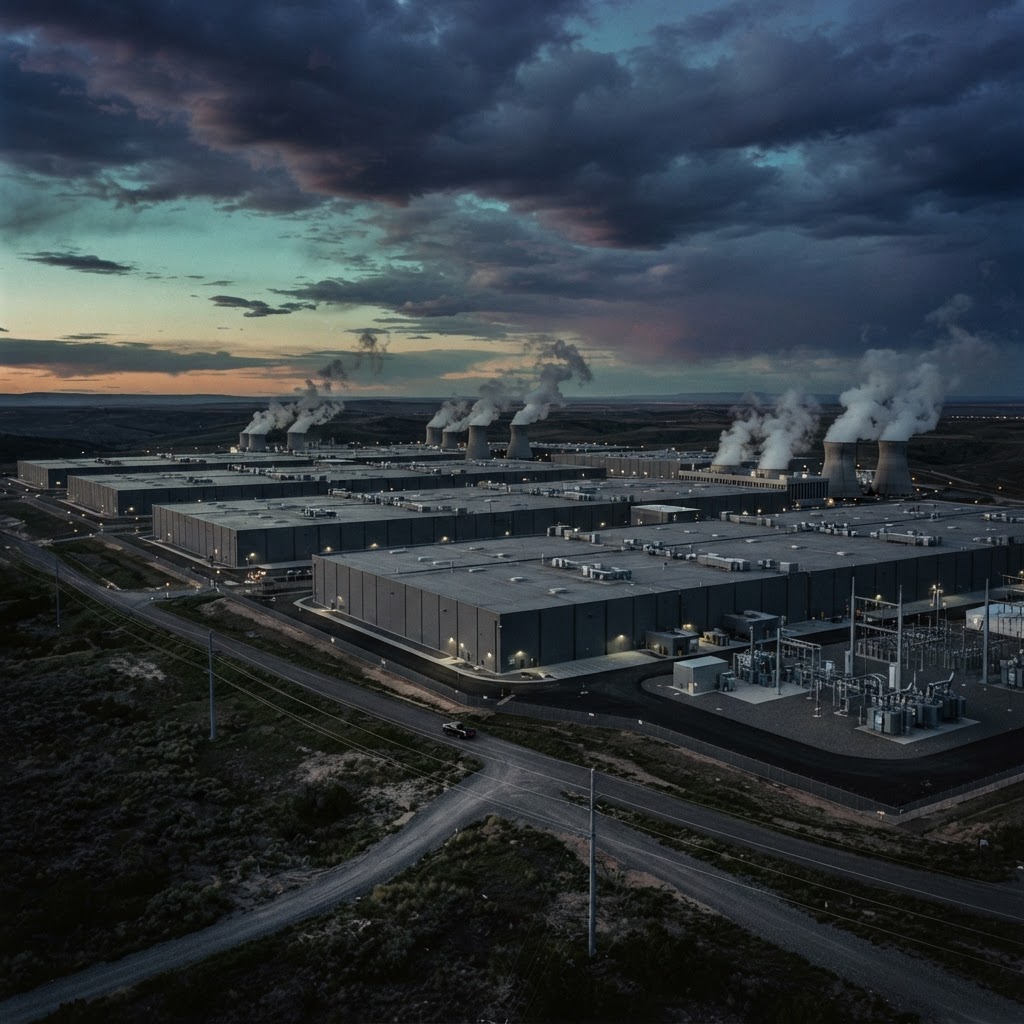
Reich opens with a useful correction. Data centers have existed since the 1940s, and for decades they were the quiet workhorses of the internet — the place "in the cloud" where your email and your Netflix lived. What is being built now is categorically different. Ben Green, an assistant professor of information and public policy at the University of Michigan, tells USA TODAY the new facilities are "orders of magnitude larger than what came before," both in individual size and in the sheer number going up.
The old standard was around 100,000 square feet. Today's hyperscale facilities — owned by Amazon, Microsoft, and Google Cloud — span millions of square feet, often more than 100,000 times the footprint of a football field. They are not built for streaming. They are built to train and run generative AI models, and they are placed in rural and suburban areas because the land is cheap and the operations must spread out rather than up.
Heat, Water, and the Bill That Comes Due
The piece walks through the physics that communities have been shouting about for years. Millions of servers packed with GPUs run at maximum capacity and generate enormous heat. To keep the systems functional, data centers rely on water-intensive cooling. A 2025 report from the Environmental and Energy Study Institute found that a single large data center can consume up to 5 million gallons of water every day — roughly the water use of a town of 10,000 to 50,000 people.
That number is not abstract. It is the reason nearly three-fourths of U.S. adults now oppose building data centers near them, according to a recent Gallup survey. The opposition crosses party lines and geography, driven by water, electricity rate increases, pressure on renewable energy, and the question of who actually gets hired once the construction crews leave.
Moratoriums Work
Reich documents what this site has tracked from the beginning: local moratoriums are the most effective tool communities have. Green puts it bluntly — "part of how the tech industry pushes forward is by operating with extreme speed and secrecy," so a pause is often the only leverage a town gets.
The results are starting to show. Between January and March of 2026, at least 75 data center projects worth roughly $130 billion were disrupted by local opposition, according to the research firm Data Center Watch. That was the largest single-quarter concentration of blocked and delayed projects on record.
The President Calls Them "Cash Cows"
The political backdrop is stark. President Donald Trump has embraced data centers as "cash cows" and on August 31 wrote on Truth Social that communities that don't want data centers "want to end up being backwards and poor." The economic argument rests almost entirely on construction jobs. A Virginia review commission found that building a 250,000-square-foot data center employs up to 1,500 construction workers — and then needs just 50 full-time staff once it opens.
Janesville, Wisconsin: The Same Battle
The article closes on the ground, in Janesville, Wisconsin, where a 250-acre former General Motors plant sat dormant and contaminated since 2008. When the developer Viridian Partners offered to buy the land for a data center, commercial broker Adam Shultz was hopeful. Then the community found out the city had been negotiating under an NDA, the tide turned, anti-data-center activists blocked the sale, and a November referendum will now let residents vote on any project over $450 million.
"It's the same battle," Shultz told USA TODAY. He is right, and it is a battle being fought in towns across the country.
Why This Piece Matters
For years the resistance to data center expansion was treated as a fringe complaint. A piece like this — in USA TODAY, reaching millions of readers — signals that the frame has shifted. The question is no longer whether data centers are bad. The question is who pays for them, who decides where they go, and whether the communities bearing the cost will keep winning the right to say no.
Read the full article at USA TODAY.
// DID THIS RESONATE?
CLICK TO SHOW YOUR SUPPORT
ORIGINAL SOURCE
USA TODAY