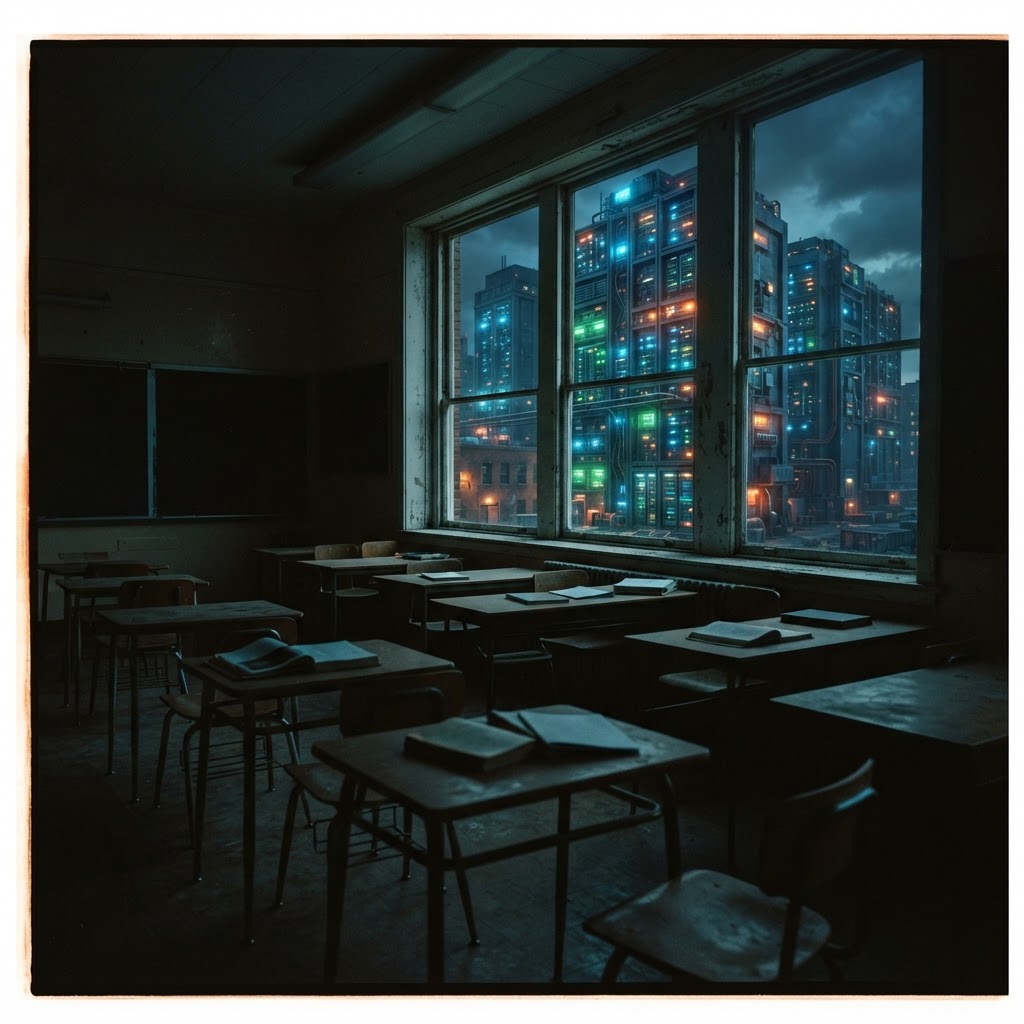
AI Is Eroding Student Minds — and the Data Centers Behind It Are Eroding the Earth
The OECD's 2025 PISA results, released September 8, 2026, confirm a collapse in student learning unprecedented in the assessment's 25-year history — and the chief culprit is the same artificial intelligence boom that is fueling a runaway global data center construction spree.
The Numbers Are Devastating
Across OECD member nations, average reading scores fell by 28 points between 2015 and 2025 — equivalent to roughly one and a half years of formal schooling. Mathematics scores dropped 22 points, about a full year of learning. One in five 15-year-olds now scores below basic proficiency in reading, mathematics, and science, up from 16% in 2022. [1]
The assessment — the largest ever conducted — covered 760,000 students across 91 countries and economies. OECD Secretary-General Mathias Cormann was blunt: "Technology and AI can strengthen learning and help prepare young people for the future, but only when used purposefully and not as a substitute for attention, effort and understanding." [1]
AI Use Correlates Directly With Worse Outcomes
The Wall Street Journal reports that OECD Education Director Andreas Schleicher identified widespread reliance on generative AI tools as a primary driver of the decline. Some 46% of students now use AI chatbots weekly for schoolwork, and the study found that students who frequently rely on AI for homework score significantly worse on closed-book exams. [2]
Outsourcing cognitive tasks to AI, Schleicher warned, turns students into "hasty" readers who process information quickly but struggle with critical evaluation, complex analysis, and long texts. Bloomberg's coverage notes that students who did not use AI to draft text outperformed those who did — a finding that cuts to the heart of the industry's pitch that AI is an educational equalizer. [3]
The decline was sharpest among socioeconomically advantaged students — the very demographic with the most access to AI tools. The gap between advantaged and disadvantaged students narrowed between 2022 and 2025, but largely because the top performers fell, not because the bottom rose. [1]
The Same Boom Is Eating the Planet
What the PISA study does not say — but what this site exists to document — is that the AI adoption hollowing out a generation's literacy is the same adoption driving the largest data center build-out in human history. Every chatbot query, every AI-drafted essay, every "hasty" skim of a summarized text routes through warehouses of servers that consume staggering volumes of electricity and water.
The OECD's own findings on digital distraction — more than one in four students report classmates distracted by devices in most science lessons — mirror the broader pattern: a technology ecosystem designed to maximize engagement and throughput, whether in a classroom or a server farm, at the expense of depth, sustainability, and human capacity. [4]
The Choice
Schleicher urged governments to adopt strict school smartphone bans and reform educational AI use toward structured "Socratic questioning" rather than letting bots perform students' research and writing. [2] The same principle applies to the infrastructure: the data center expansion now consuming watersheds, farmland, and power grids across the globe is not inevitable. It is a policy choice, made in service of a product that — by the OECD's own rigorous measurement — is making the people who use it measurably worse at thinking.
The question is not whether AI can be useful. It is whether a technology that degrades the minds of the young and the land they will inherit is worth the cost. The OECD has now quantified the first half of that equation. This site exists to quantify the second.
Sources
[1] OECD, "PISA 2025: Students' reading and mathematics performance declined sharply across the OECD," September 8, 2026. oecd.org
[2] Wall Street Journal, "AI Use Contributes to Global Decline in Student Reading Skills, OECD Says," September 8, 2026. wsj.com
[3] Bloomberg, "School Students Who Use AI Get Worse Test Scores, OECD Warns," September 8, 2026. bloomberg.com
[4] Euronews, "Pupils getting worse at reading, maths and science, PISA study shows," September 8, 2026. euronews.com
[5] The Economic Times, "15-year-olds are reading, calculating and reasoning worse than ever, thanks to AI, OECD finds," September 8, 2026. economictimes.com
// DID THIS RESONATE?
CLICK TO SHOW YOUR SUPPORT
ORIGINAL SOURCE
OECD / Wall Street Journal / Bloomberg