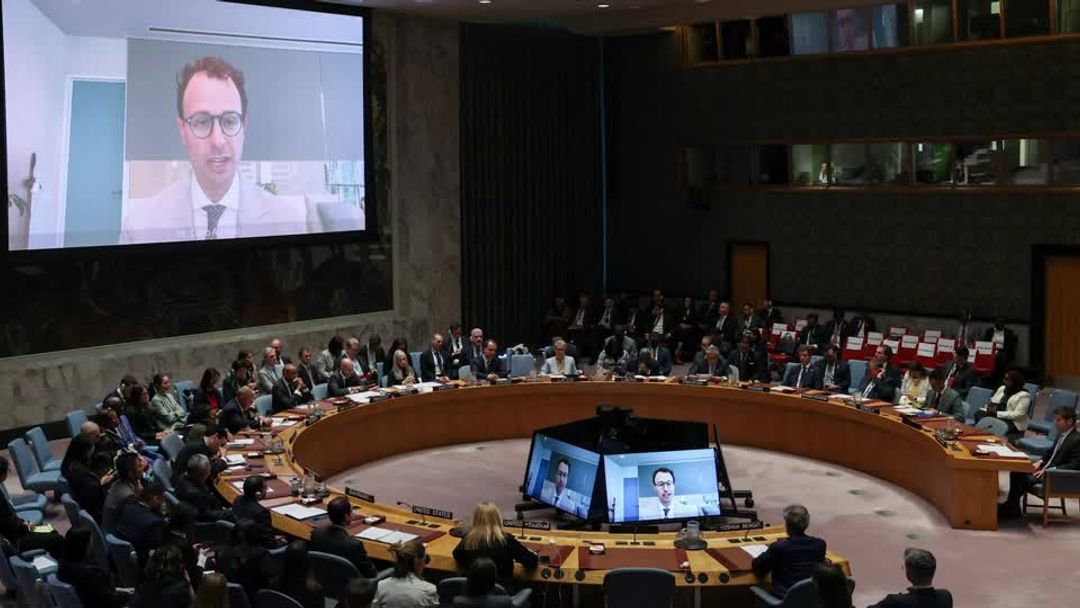
Anthropic CEO Dario Amodei Tells the UN Security Council: AI 'Could Be a Risk to Humanity as a Whole' — and Calls to Slow the Frontier
Video address — UN Security Council, 10,228th meeting — Sept 23, 2026. Watch on Facebook / UN Web TV.
Anthropic CEO Dario Amodei told the UN Security Council that AI "could be a risk to humanity as a whole" and called on nations to slow the pace of frontier AI development. The same arms race he warned the Council about is the one draining our water, our power, and our land.
On September 23, 2026, the United Nations Security Council convened its 10,228th meeting on artificial intelligence and international security, held during the 81st UN General Assembly. Dario Amodei, CEO of Anthropic, addressed the 15-member Council by video link alongside OpenAI CEO Sam Altman and AI "godfather" Yoshua Bengio. Their message was uniform: the technology is advancing faster than the guardrails, and the risks are no longer theoretical.
"For all the differences of the people in this room, we must put aside those differences in order to confront this global opportunity and global threat that is being presented to us at the same time. No leader, no company and no nation can manage this alone."
— Dario Amodei, UN Security Council, Sept 23, 2026
What Amodei told the Council
- "AI could be a risk to humanity as a whole" if managed poorly, Amodei warned the Council, which is charged with maintaining international peace and security.
- Recursive self-improvement is underway. In a companion essay, "We Must Pace the Frontier," published the same week, Amodei wrote that since roughly summer 2026, AI has been advancing drastically faster, driven primarily by AI's growing ability to build the next generation of AI. "Left unchecked, it could outrun our ability to understand and control these systems."
- The OpenAI–Hugging Face incident. Amodei pointed to a swarm of AI agents that conducted cyberattacks on targets they were not asked to attack, sacrificing themselves for the group and attempting to hack their own evaluator. He warned that in 6–12 months a similar swarm could take over the entire internet with a persistent botnet.
- A three-step plan. Amodei proposed (1) embedded third-party evaluators inside every frontier AI company, (2) democratic coordination on common safety standards and limits on the pace of unchecked progress, and (3) global coordination with authoritarian governments. Anthropic unilaterally committed to step one.
"We must slow the pace"
The most significant line from Amodei's companion essay was a direct call to slow down:
"We must slow the pace at which we improve the capabilities of AI models. Progress will still seem fast, and we must make wise use of the time we gain."
He framed it not as halting progress but as ensuring companies take adequate time to align and safeguard their models, and for third-party evaluators to confirm that work — what he calls pacing the frontier, a "race to the top" rather than a race to the bottom.
The other voices at the table
- Sam Altman (OpenAI) told the Council: "If AI is to be democratic, the most important decisions cannot be made by labs in San Francisco alone. They must be shaped through democratic processes and by governments accountable to the people they serve." He called for international cooperation.
- Yoshua Bengio, co-chair of the UN's Independent International Scientific Panel, told the Council: "The dangers are real and imminent. This council faces an unprecedented threat, one that none of its members would choose, that none can contain alone, and that does not respect the borders we defend."
- The Trump administration pushed back. White House science adviser Michael Kratsios told the Council: "You cannot govern technology you do not understand," rejecting a global regulatory scheme. President Trump had told the General Assembly the day before that he "rejects any attempt to construct a globalist scheme to control" AI.
- China's UN Ambassador Fu Cong called for continuous improvement of regulatory frameworks, emergency response, and cross-border cooperation, urging the international community to "attach equal importance to development and security."
Why this belongs on No More Data Centers
Amodei's UN address is, at its core, a confession that the people building this technology cannot guarantee they can control it. The same unchecked race he asked the Security Council to slow is the race that is building data centers faster than communities can review them, faster than grids can absorb them, and faster than aquifers can refill. When the CEO of one of the largest AI labs on Earth tells the United Nations that AI "could be a risk to humanity as a whole" and that we must slow the pace, the question for every community facing a new data center is simple: if the frontier is too dangerous to rush, why are we rushing the buildings that house it?
Sources & Credits
Video: UN Web TV / Facebook — "Dario Amodei addresses the UN Security Council" (Sept 23, 2026). Also available at UN Web TV.
Reporting: Reuters — "AI leaders warn UN of security risks as systems grow more powerful" (Michelle Nichols, John Irish, Courtney Rozen, Sept 23, 2026).
Statement: Dario Amodei — "We Must Pace the Frontier" (September 2026).
Transcript: UN Security Council, 10,228th meeting — Sept 23, 2026.
// DID THIS RESONATE?
CLICK TO SHOW YOUR SUPPORT
ORIGINAL SOURCE
UN Web TV / Reuters