Flock Safety Pitched Turning 350,000 Uber and Lyft Cars Into Roaming License Plate Readers
"Trust us — they only read license plates. And we only want to hide the cameras from people to protect them."
— What Flock Safety's rideshare pitch sounds like, if you say it out loud.
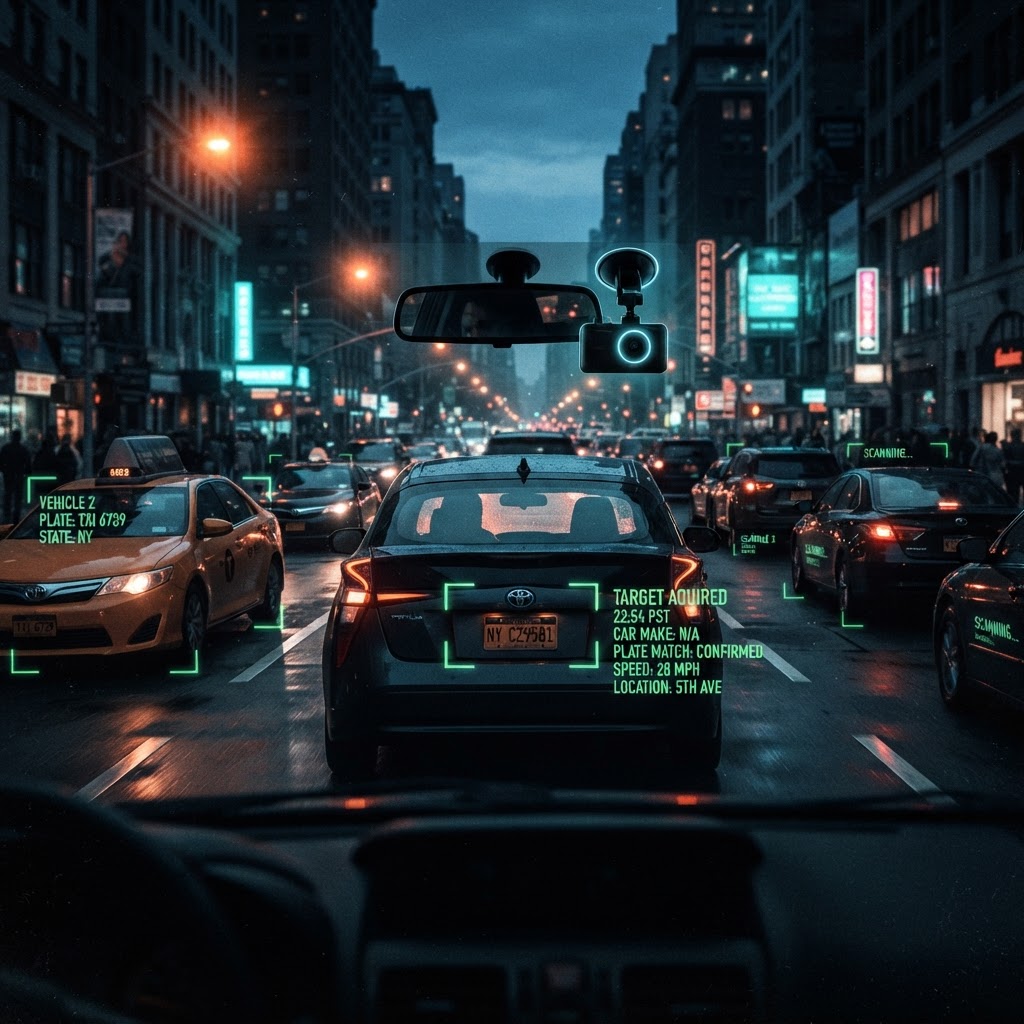
Flock Safety, the Atlanta-based company whose solar-powered license plate readers already line roadsides across the country, once pitched a plan to turn roughly 350,000 Uber, Lyft, and delivery vehicles into roaming surveillance cameras, scanning the license plates of every car they passed.
The plan — documented in a presentation obtained through a Georgia public-records request and first reported by 404 Media in August 2026 — described a potential integration with Nexar, a consumer dashcam company that markets its cameras to rideshare drivers as a personal-safety product. Flock told reporters the partnership never happened.
But the pitch reveals the direction of the company's ambition: away from the limits of where a camera can be bolted to a pole, toward a distributed collection system riding in the cars of gig workers who signed up for a dashcam — not a police contract. The reporting does not establish whether drivers would have been told.
"They only read license plates"
That is the comforting line. Here is what it leaves out. Modern automated license plate readers (ALPRs) do not merely photograph a plate — they log the time, date, GPS location, and direction of every vehicle that passes, building a searchable record of where a car has been and when. Stitched together across a network, those reads produce a detailed map of a person's daily movements.
In Providence, Rhode Island alone, the city's Flock transparency portal reported 685,934 vehicles detected in a single 30-day period — in a city of fewer than 200,000 people. The ACLU of Rhode Island counts at least 295 Flock cameras statewide, and cautions the true number is hard to pin down.
"We just want to hide them to protect people"
Protect whom, exactly? A network that quietly logs the movements of hundreds of thousands of residents — with no comprehensive state statute governing how long the data is kept or which agencies can search it — does not protect the public. It protects the system from public scrutiny.
Rhode Island has no comprehensive ALPR statute. Bill H8077, introduced February 27, 2026 to regulate collection, sharing, and search logs, was recommended for "further study" on March 24 and never became law. The ACLU's assessment of the gap is blunt: the readers capture far more than plate numbers, feed a national network, and operate, in the organization's words, "virtually unregulated."
The pushback is already happening
In the six weeks before the reporting, three Rhode Island towns voted to cancel their Flock contracts: South Kingstown (unanimous, July 27), Narragansett (unanimous, August 3), and Glocester (4–1, August 6). Three more communities — Little Compton, Warren, and Portsmouth — rejected or halted proposed installations.
If a town can vote a surveillance network out, a state can refuse to let a private company quietly fold its residents' cars into one. The question is not whether the technology can be built. It is whether the public gets to decide whether it should be.
Sources & Credits
Primary: "Flock pitched turning Uber and Lyft drivers into a mobile surveillance network," Mashable (leaked document, ~350,000 rideshare vehicles).
Original reporting: "Flock Pitched a Plan To Turn Uber and Lyft Drivers Into Roaming Surveillance Vehicles," 404 Media (Joseph Cox, Aug 7, 2026).
Context & data: "Flock Pitched Uber Cars as Roving Plate Readers," Uprise RI (RI camera inventory, town cancellations, H8077).
Policy: RI H8077 — Automated License Plate Readers (introduced Feb 27, 2026; stalled in committee).
Data: Providence PD Flock Transparency Portal (60 cameras, 685,934 vehicles detected / 30 days).
// DID THIS RESONATE?
CLICK TO SHOW YOUR SUPPORT
ORIGINAL SOURCE
Mashable / 404 Media / Uprise RI