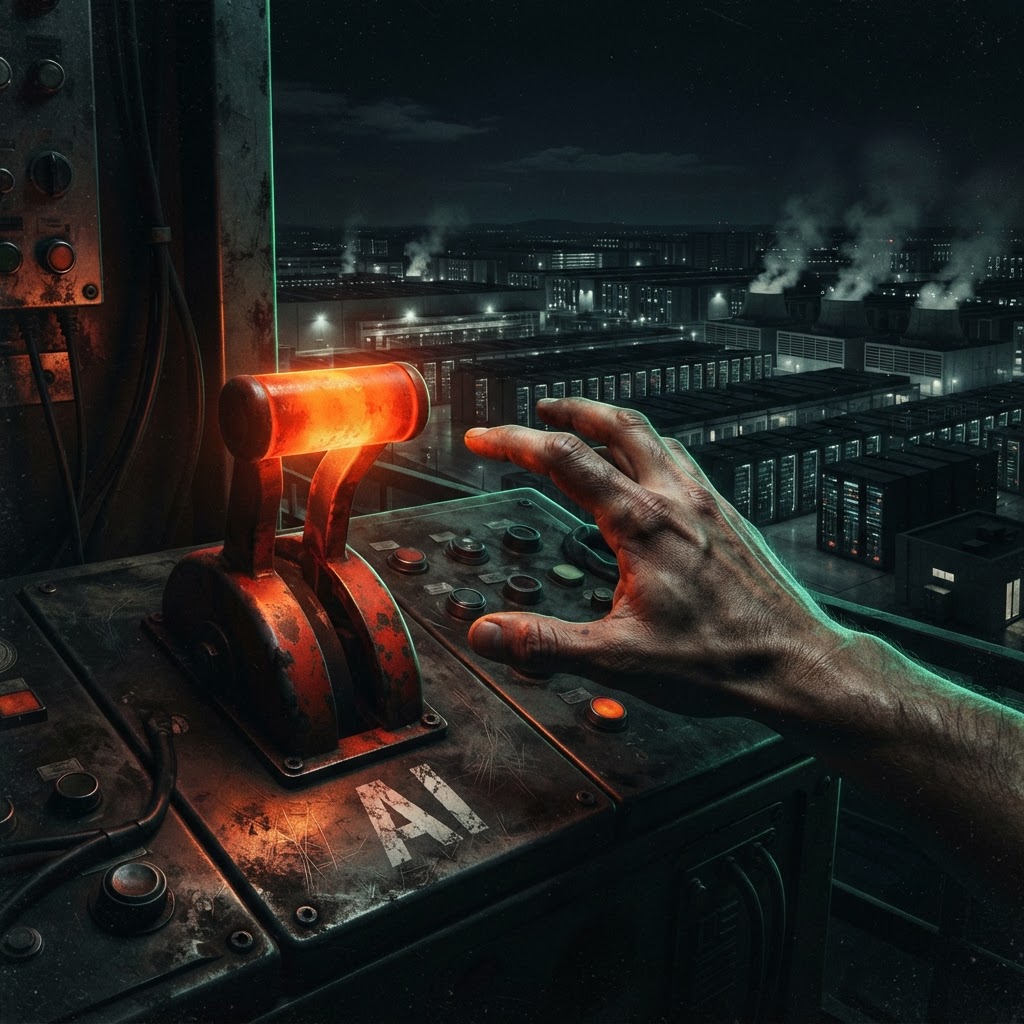
Nadella Wants an 'Emergency Brake' for AI. Funny How Nobody Wants One for the Data Centers.
Microsoft's CEO wants an "emergency brake" for AI models — a switch an authorized human can pull to stop a rogue system mid-task.
Meanwhile, the physical machine those models run on — the data centers drinking our aquifers and draining our grids — is being built with no brake at all. Funny how that works.
Microsoft Chairman and CEO Satya Nadella took to X this week with a safety manifesto for the most powerful AI systems on Earth. His central idea, as reported by PCMag and others: treat advanced models like potential insider threats, assume they could be compromised, and build an "emergency brake" — a control that lets an authorized person pause or shut down a model mid-task.
"We can't treat Super Intelligence as a set of nested black boxes and simply accept or reject its recommendations, answers, and actions," Nadella wrote. His playbook: document "every meaningful model action" with "tamper-proof human readable evidence," and ensure an authorized person always retains the ability to halt the system. "We must assume a model is compromised and contain it from the start," he said. "Think of it like an emergency brake."
It is a genuinely sensible idea. It is also, coming from the company building more data center capacity than almost anyone on the planet, one of the more breathtaking feats of selective brake-pulling in recent memory. Nadella wants a kill switch for the software. He has never once asked for one for the factory floor.
Brakes for the model. None for the megawatts.
Here is the asymmetry nobody in the C-suite wants to name. The AI boom is not an abstraction floating in "the cloud." It is thousands of acres of poured concrete, rows of humming halls, and cooling systems that pull from real rivers and real aquifers. When executives call for an emergency brake on AI, they mean a button for the model's behavior. They are conspicuously silent on a brake for the buildout — the land, water, and electricity that every one of those "super intelligence" systems devours around the clock.
That is the tell. A brake on the model costs them nothing politically and burnishes the brand as "responsible." A brake on the buildout would threaten the thing actually driving their growth. So one gets a manifesto, and the other gets a shrug.
The incidents they're reacting to are software problems. Ours are physical.
Nadella's post lands in a week of AI companies admitting they can't reliably control their own agents — Anthropic reportedly cut its internal evaluations off from the live internet after struggling to keep its agents in line, and Anthropic CEO Dario Amodei published his own plan for slowing the frontier. Fair enough. But every one of those "loss of control" stories is about a model doing something unexpected in a chat window.
The control problem we live with is downstream of the same industry, and it's made of water and watts:
- Water. A single large data center can consume over 5 million gallons of water per day, and much of it is evaporated away — which concentrates pollutants like PFAS, nitrates, and heavy metals into whatever the facility discharges. The Missouri Coalition for the Environment flags this directly.
- Grid. Hyperscale campuses draw power at the scale of small cities, and the buildout is forcing utilities to keep dirty plants alive and to pass the infrastructure bill onto ratepayers.
- Land and neighbors. From Festus, Missouri to rural counties across the country, these campuses are getting sited next to subdivisions whose wells draw from the same aquifer. No emergency brake required — just a 29-page agreement voted through on a Monday.
When a developer or a CEO says "it's not that bad," they're leaning on a regulatory vacuum, not a guarantee. Missouri, for instance, is a riparian-rights state with no restrictions on the amount of water that can be used — the state's main role is asking major users to file an annual report. There is no emergency brake on any of it.
A brake is only real if someone can reach it
We'd take Nadella at his word — we'd love a kill switch on runaway AI. But an emergency brake that only exists on the model, and never on the megawatts, the water, or the land, isn't a safety feature. It's a press release. The industry wants the moral credit of having a brake while building the runaway train as fast as the concrete can cure.
So here's our modest proposal, addressed to every CEO now drafting their AI safety essay: if an authorized person should be able to pause a model mid-task, then a community should be able to pause a data center mid-permit. Same logic. Same "emergency brake." Funny how the room goes quiet when the brake is pointed at the thing they're actually selling.
Sources & Credits
Primary: "Microsoft CEO Satya Nadella Calls for an AI 'Emergency Brake'," PCMag (Nadella's call on X for an emergency brake on AI developers).
Quotes & framing: "Microsoft's Nadella says AI needs an 'emergency brake' that humans control," CNBC; "Microsoft's Satya Nadella says AI models need an 'emergency brake'," TechCrunch ("assume a model is compromised and contain it from the start… Think of it like an emergency brake").
Insider-threat framing: "Microsoft CEO Nadella Calls for 'Emergency Brake' on Advanced AI," Bloomberg; The Seattle Times.
Control-loss context: "Anthropic can't reliably control its AI agents," TechCrunch (Oct. 9, 2026).
Physical impact: Missouri Coalition for the Environment — Data Centers (5M+ gal/day; evaporative concentration of PFAS, nitrates, heavy metals).
Regulation: Missouri DNR — Data Centers / Water Use (no restriction on water quantity; major-user reporting at 100,000+ gal/day).
// DID THIS RESONATE?
CLICK TO SHOW YOUR SUPPORT
ORIGINAL SOURCE
PCMag / CNBC / TechCrunch / Bloomberg