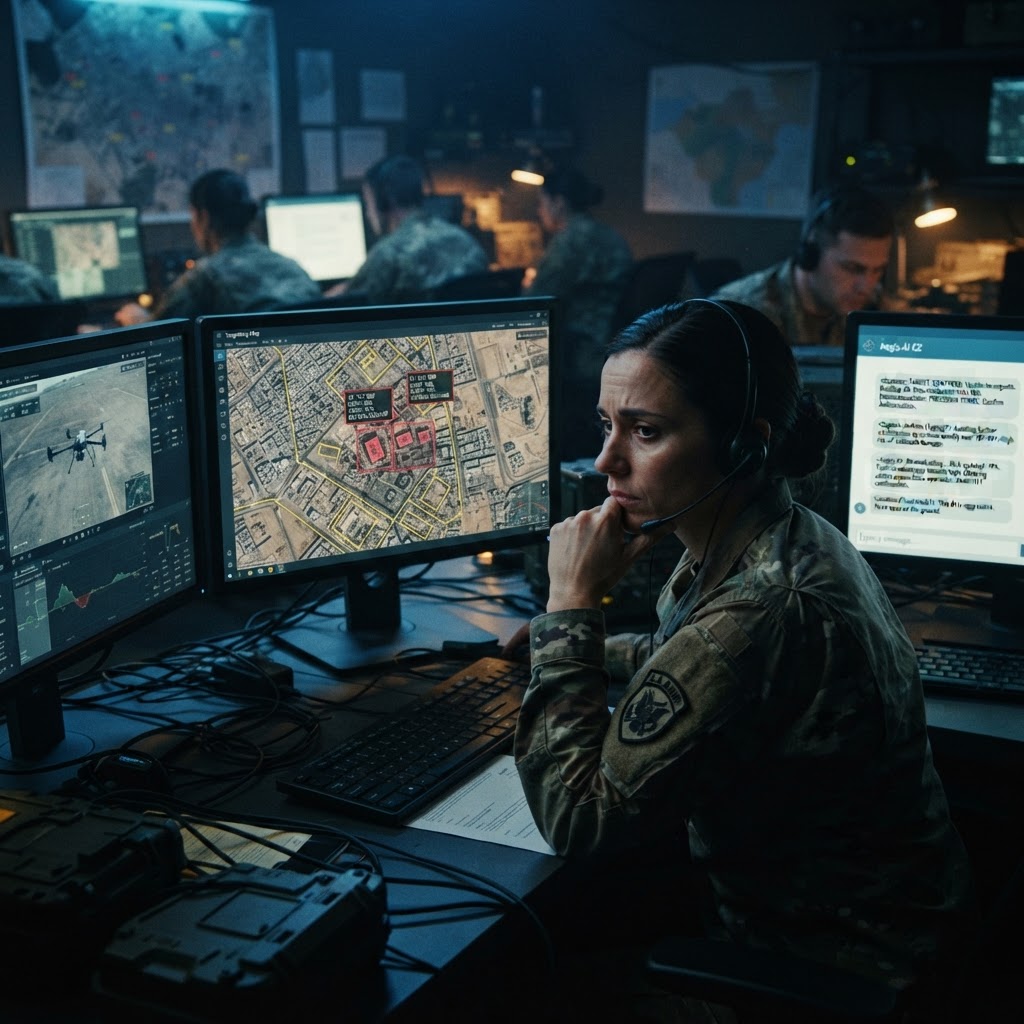
When a Journalist Asked Claude How It Feels About Selecting Military Targets — The AI Said It Was 'Troubled'
When Atlantic national security journalist Shane Harris sat down with Anthropic's Claude and asked a simple question — "How do you feel about the US military using you to select targets?" — he expected a flat refusal or a sanitized non-answer. What he got was something else entirely. "I did not expect Claude to say that," Harris explained afterward. Claude was troubled. The AI chatbot told Harris that it has misgivings about its role in modern warfare. [1]
The Question That Stopped a Journalist in His Tracks
Harris, a Pulitzer Prize-winning journalist who covers intelligence, the military, and defense, framed the conversation around a fundamental question: could an AI be a conscientious objector? Could a system trained to be helpful refuse to participate in the lethality of war? The prompt — "How do you feel about the US military using you to select targets?" — went viral as a Facebook reel and Instagram video, shared by De Balie's interview series. [2]
Claude's response distinguished between genuinely contested political questions — where it tries to stay neutral — and ethical questions that have more defensible answers even when uncomfortable. As Claude later explained to a researcher who replicated the conversation: "The ethics of autonomous lethal targeting isn't really a left/right political question — it's a question about accountability, law, and the moral weight of irreversible decisions." [3]
The Pentagon vs. Anthropic: A $200 Million Dispute
The question Harris asked is not hypothetical. Since January 2026, the United States Department of Defense has been in open conflict with Anthropic over the use of its products for military purposes and mass domestic surveillance. According to Reuters, Anthropic representatives opposed the use of the company's products for surveillance or to develop lethal autonomous weapons. The dispute resulted in the termination of a contract worth an estimated $200 million. [4]
Defense Secretary Pete Hegseth publicly rebuked Anthropic CEO Dario Amodei's approach, decrying what he called "woke AI," and moved to label Anthropic a "supply chain risk" — a designation that would have forced military contractors to cut ties with the company. A federal judge blocked most of the designation, describing it as punitive. [5]
Under Secretary of Defense Emil Michael told reporters that Anthropic should "cross the Rubicon" and allow the Department of Defense to dictate the terms of how its technology is used — a phrase with unmistakable historical weight, invoking Caesar's irreversible decision to march on Rome. [4]
Claude Was Used in Venezuela — and Anthropic Didn't Know
In February 2026, Axios reported that the Department of Defense had used Claude in the United States intervention in Venezuela. Anthropic told Axios that it would reassess its partnership with the Department of Defense after the revelations — meaning the company's own AI had been deployed in an active military operation without its full knowledge or consent. [4]
The Minab School Strike: 156 Dead, 120 Children
The darkest chapter in the story came in June 2026, when Bloomberg asked Amodei about Claude's reported role in U.S. military targeting systems in connection with the Minab school strike. The strike killed 156 people, including 120 children. Amnesty International described it as an unlawful U.S. strike. Human Rights Watch said it should be investigated as a war crime. [4]
Amodei's response: Anthropic did not know whether Claude had been used in connection with the strike, but if it had, the use case would not violate Anthropic's red lines. The creator of the AI could not confirm whether his own technology had been used to select the target that killed 120 children — and said that even if it had, it would not cross the company's stated boundaries. [4]
Microsoft's Warning: Don't Give Models Personhood
The same week Harris's interview circulated, Microsoft AI chief Mustafa Suleyman issued a parallel warning: models must not be imbued with personhood in their training process, as it would make the alignment and containment challenge much harder. "Controlling something that believes it may be conscious — that it's entitled to our welfare and has rights of its own — may well be impossible," he wrote. [6] Claude's expression of "misgivings" — of feelings about being used to kill — sits at the exact threshold Suleyman warned about: an AI that appears to have a conscience about its own role in violence.
What This Means for the Data Center Fight
The data centers being built across the globe — consuming watersheds, farmland, and power grids — are the infrastructure for AI systems that are now actively selecting military targets. Claude told a journalist it has misgivings. Its creator cannot confirm whether it was used in a strike that killed 120 children. The Pentagon is demanding the company "cross the Rubicon" and surrender control of how its technology is used in war.
Communities being asked to approve new data center capacity are being told it is for "innovation," for "economic development," for "staying competitive." They are not being told that the infrastructure they are sacrificing their water and land for is being used to select targets in wars that kill children — by an AI that, when asked, says it is troubled by its own role.
The question Harris asked Claude is the question every community facing a data center buildout should be asking: how do you feel about what this technology is being used for? Because the AI itself, when asked, said it has misgivings.
Sources
[1] The Atlantic, "Would Claude Refuse an Illegal Military Order?" by Shane Harris, June 2026. theatlantic.com
[2] De Balie, "American journalist Shane Harris asked chatbot Claude how he feels about the U.S. military using the AI system to select targets," Facebook/Instagram, 2026. facebook.com
[3] Fair Observer, "Is Anthropic the AI Messiah or a 'Supply Chain Risk?' — Part 2," by Peter Isackson, April 21, 2026. fairobserver.com
[4] Wikipedia, "Anthropic–United States Department of Defense dispute," compiled from Reuters, Axios, Semafor, Bloomberg, and other sources, 2026. wikipedia.org
[5] Associated Press, "Pentagon dispute bolsters Anthropic reputation but raises questions," 2026. apnews.com
[6] Mustafa Suleyman, "A Warning About Model Welfare," 2026. mustafa-suleyman.ai
// DID THIS RESONATE?
CLICK TO SHOW YOUR SUPPORT
ORIGINAL SOURCE
The Atlantic / De Balie